
When I consider the tapestry of European travel, three destinations immediately stand out, each a jewel in the continent’s crown: Spain, Italy, and France. These nations, steeped in history and brimming with culture, offer a breadth of experiences that can satisfy even the most discerning traveler. My own journeys through these lands have left me with a profound appreciation for their unique contributions to the global cultural landscape. Let me share with you a perspective on why these three countries, in particular, warrant a place at the forefront of any European exploration.
For me, Spain is a vibrant flamenco dancer, her every movement a testament to a rich and multifaceted past. It’s a country where the echoes of Moorish sultans mingle with the grandeur of Christian kings, and where the sun seems to paint the landscape with an intensity found nowhere else. My exploration of Spain has consistently revealed a country that pulsates with life, from the bustling metropolises to the tranquil villages etched into rolling hillsides.
Andalucía: The Soul of Spain
My first significant immersion into Spain was in Andalucía, and it’s a region that continues to hold a special place. This southern territory is a crucible of cultures, a place where the legacy of Moorish rule is not just an artifact of history but a living, breathing presence.
The Alhambra in Granada: A Testament to Architectural Brilliance
Visiting the Alhambra in Granada was like stepping into a meticulously crafted dream. This palace and fortress complex is a masterpiece of Islamic architecture, a testament to the artistry and engineering prowess of its creators. The intricate geometric patterns, the serene courtyards with their burbling fountains, and the breathtaking views over the city – each element sings a song of exquisite design. I recall standing in the Court of the Lions, the namesake fountain a centerpiece of delicate stonework, and feeling a profound sense of connection to centuries past. The Nasrid Palaces, with their muqarnas ceilings and stucco work, are a sensory feast, each chamber revealing a new level of detail and refinement. It’s a place that demands slow contemplation, allowing the layers of history and artistry to unfurl at their own pace.
Seville: The Heartbeat of Flamenco
Seville, for me, is the very essence of Spanish passion. The city breathes flamenco, and to witness a performance here is to experience a raw, unadulterated expression of emotion. I’ve spent many evenings mesmerized by the rhythmic clapping, the soulful singing, and the fiery footwork that tells stories of love, loss, and pride. The Alcázar of Seville, another stunning example of Mudéjar architecture, further deepens the Andalusian experience, its gardens a labyrinth of fragrant blooms and trickling water. Wandering through the Santa Cruz barrio, with its narrow, winding streets and hidden plazas, feels like navigating a living museum.
Córdoba: A Crossroads of Faiths
Córdoba offers a unique perspective on Spain’s complex religious history. The Mezquita-Cathedral, a sprawling edifice that began as a mosque and later had a cathedral built within its walls, is a truly astonishing architectural statement. The endless rows of red-and-white striped arches create a forest of columns that dwarf the observer, drawing the eye upwards to the intricate domes. This is a place where different faiths have coexisted, and sometimes clashed, leaving behind a physical manifestation of that dialogue. The Judería, the old Jewish Quarter, with its whitewashed walls and flower-filled patios, offers a glimpse into another significant chapter of Cordoban history.
Catalonia: A Vibrant Artistic Hub
Moving north, Catalonia presents a different, yet equally compelling, facet of Spain. This region is a powerhouse of creativity, with Barcelona as its dazzling epicenter.
Gaudí’s Barcelona: Beyond Architecture
Barcelona, to me, is inextricably linked with the visionary works of Antoni Gaudí. His buildings are not merely structures; they are organic sculptures that seem to have sprung from the earth itself. The Sagrada Família, though still unfinished, is a breathtaking testament to his unique design philosophy, its soaring spires and intricately carved facades reaching towards the heavens. I’ve spent considerable time marveling at the whimsical nature of Park Güell, a public park that feels like a fantastical playground, with its mosaic-covered benches and gingerbread-like houses. Casa Batlló and Casa Milà, with their undulating facades and organic forms, further showcase Gaudí’s ability to transform stone and iron into something fluid and alive. His work is a profound reminder that architecture can be an art form that engages all the senses.
The Gothic Quarter: A Journey Through Time
Beyond Gaudí, Barcelona’s Gothic Quarter is a dense labyrinth of medieval streets, hidden courtyards, and ancient churches. Getting lost here is not a misfortune but an opportunity to discover hidden gems, from tiny tapas bars to centuries-old artisan workshops. The Barcelona Cathedral, with its imposing presence, anchors one end of this historic district, offering a counterpoint of solemn grandeur to the bustling plazas.
Madrid: The Imperial Capital
As Spain’s capital, Madrid exudes an air of regal elegance and cultural richness. It’s a city that has served as the political and artistic heart of the nation for centuries.
The Golden Triangle of Art: A Curator’s Dream
For any art enthusiast, Madrid’s “Golden Triangle of Art” is an unparalleled pilgrimage. The Prado Museum houses an extraordinary collection of European art, with masterpieces by Velázquez, Goya, and El Greco that feel almost alive on their canvases. I remember standing before Goya’s “The Third of May 1808,” the stark depiction of execution sending a shiver down my spine. The Reina Sofía Museum, home to Picasso’s monumental “Guernica,” offers a modern and searing indictment of war. The Museo Thyssen-Bornemisza bridges the gap, showcasing a diverse range of Western art from the 13th century to the 20th, providing a comprehensive overview of artistic evolution.
Royal Palace and Retiro Park: Echoes of Royalty and Relaxation
The sheer scale and opulence of the Royal Palace are a testament to Spain’s royal past. Wandering through its grand halls and elaborately decorated rooms offers a glimpse into the lives of monarchs. Adjacent to this grandeur lies Retiro Park, a verdant oasis in the heart of the city. It’s a place where Madrileños come to relax, sail on the lake, and escape the urban bustle, providing a much-needed breath of fresh air.
If you’re looking for some of the best countries to visit in Europe, you might also find interest in exploring underrated capitals that offer unique experiences away from the typical tourist trails. A great resource for this is the article titled “10 Most Underrated Capitals in Europe: Explore Hidden Gems Beyond the Usual,” which highlights lesser-known cities that are rich in culture and charm. You can read it here: 10 Most Underrated Capitals in Europe.
Italy: The Cradle of Western Civilization
If Spain dances, then Italy sings opera, its melodies echoing through millennia of history and artistic achievement. For me, Italy is the bedrock upon which much of Western civilization was built, a country whose impact on art, architecture, cuisine, and political thought is immeasurable. My travels here have consistently felt like traversing a living museum, each corner revealing another layer of its profound legacy.
Rome: The Eternal City’s Enduring Power
Rome is not just a city; it’s a civilization encapsulated. It’s a place where the ancient and the modern coexist in a fascinating, if sometimes chaotic, embrace.
The Colosseum and Roman Forum: Ghosts of an Empire
Standing within the colossal embrace of the Colosseum, I can almost hear the roar of the crowds, the clash of gladiatorial combat. It’s a stark reminder of the power and spectacle of the Roman Empire. Adjacent to it, the Roman Forum, once the bustling heart of Roman public life, offers a poignant collection of ruins – temples, basilicas, and arches – that whisper tales of emperors, senators, and ordinary citizens. Walking amongst these weathered stones, I feel a tangible connection to a distant past, a past that shaped the very foundations of Western society. The Pantheon, with its awe-inspiring dome and oculus, remains an architectural marvel, a testament to Roman engineering that has endured for nearly two millennia.
The Vatican City: A Spiritual and Artistic Treasure Trove
Vatican City, an independent state within Rome, is a realm of immense spiritual and artistic significance. St. Peter’s Basilica, a masterpiece of Renaissance architecture, is a breathtaking spectacle, its vast dome dominating the Roman skyline. Inside, Michelangelo’s Pietà is a sculpture of such delicate beauty and profound emotion that it compels quiet reverence. The Vatican Museums hold an unparalleled collection of art and artifacts, culminating in the Sistine Chapel. Gazing up at Michelangelo’s ceiling and The Last Judgment is an experience that transcends mere visual appreciation; it’s a spiritual and artistic awakening. The sheer scale and intricacy of the work are staggering, leaving me in a state of humble astonishment.
If you’re planning a trip to Europe and looking for some breathtaking destinations, you might want to check out Switzerland, which offers stunning landscapes and vibrant cities. For more information on the best places to visit in this beautiful country, you can read a related article that highlights top destinations in Switzerland. This resource provides insights into must-see locations and activities that will enhance your travel experience. You can find it here: best places to visit in Switzerland.
Florence: The Renaissance Embodied
Florence, for me, is the beating heart of the Renaissance, a city that redefined art and culture for the world.
The Uffizi Gallery and Accademia Gallery: Masterpieces of the Masters
The Uffizi Gallery is essentially a pilgrimage for anyone who appreciates Renaissance art. Seeing Botticelli’s “The Birth of Venus” and Leonardo da Vinci’s “Annunciation” in person, after so many years of seeing them only in reproductions, is a deeply moving experience. The delicate brushwork, the vibrant colors, the sheer genius on display – it’s overwhelming in the most wonderful way. The Accademia Gallery, most famously, is home to Michelangelo’s David. The sheer scale and anatomical perfection of this sculpture are astounding, a testament to human potential and artistic mastery. I remember the feeling of being dwarfed by its presence, a visceral reminder of the power of human creativity.
The Duomo: A Symbol of Innovation
Florence’s Duomo, the cathedral of Santa Maria del Fiore, with Brunelleschi’s revolutionary dome, is a dominant and iconic feature of the cityscape. Its construction was an engineering feat that pushed the boundaries of what was thought possible at the time. Climbing to the top offers panoramic views of the red-tiled roofs and rolling Tuscan hills, a classic Italian vista.
Venice: A City Adrift in Dreams
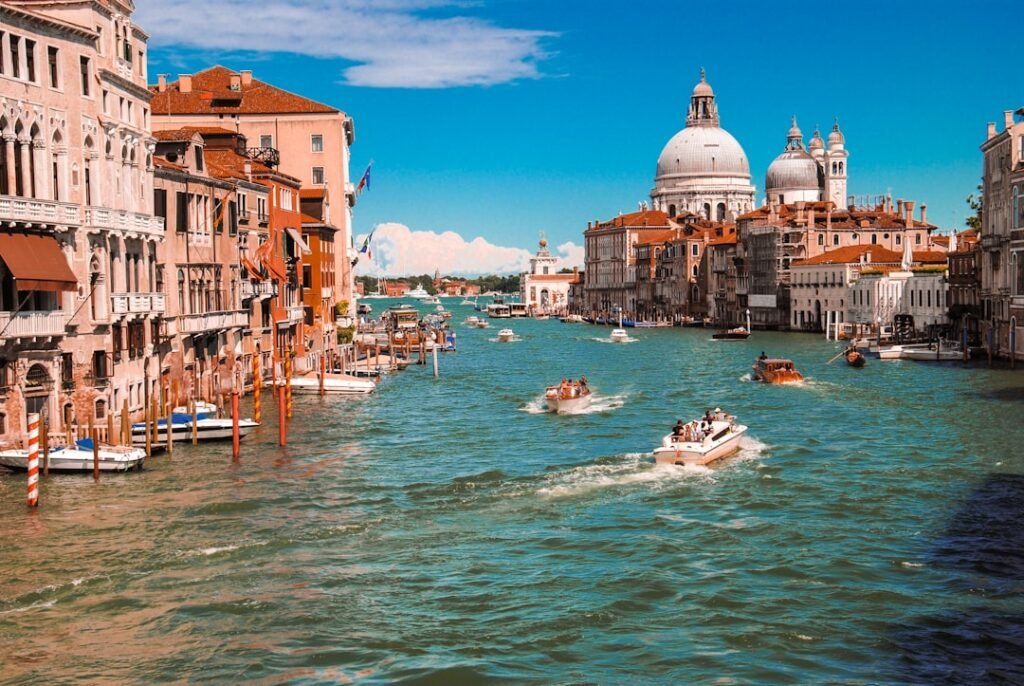
Venice is unlike any other city I have encountered. It’s a city built on water, a surreal and romantic landscape that feels as though it might melt away with the next tide.
St. Mark’s Square and Basilica: A Piazza of Legends
St. Mark’s Square, with the magnificent St. Mark’s Basilica at its heart, is an iconic Italian landmark. The basilica’s opulent mosaics, glittering with gold, speak of Venice’s historical wealth and connection to the East. The Doge’s Palace, a stunning example of Venetian Gothic architecture, adjacent to the Basilica, tells stories of power, intrigue, and the republic’s unique form of governance. The Bridge of Sighs, a poignant link between the palace and the prison, evokes images of prisoners catching their last glimpse of freedom.
Gondola Rides and Canals: The City’s Arteries
A gondola ride through Venice’s labyrinthine canals is an almost mandatory experience. Gliding silently through the waterways, under ancient bridges, with the gentle lapping of water against stone, is a uniquely enchanting way to see the city. The canals are the lifeblood of Venice, its streets and highways, and experiencing them from this perspective is essential.
Naples and the Amalfi Coast: Passion and Coastal Splendor
My journey south to Naples and the Amalfi Coast introduced me to a different kind of Italian beauty, one characterized by vibrant energy and dramatic landscapes.
Pompeii and Herculaneum: Frozen in Time
The archaeological sites of Pompeii and Herculaneum offer an unparalleled glimpse into daily life in Roman times, preserved by the catastrophic eruption of Mount Vesuvius. Walking through these remarkably intact cities, I can see the layout of homes, shops, and public buildings, and even the ruts worn by chariot wheels in the stone streets. It’s a profoundly moving and educational experience, a stark reminder of the fragility of life.
The Amalfi Coast Drive: A Spectacle of Nature
The drive along the Amalfi Coast is a sensory overload of breathtaking beauty. The sheer cliffs plunge into the azure Mediterranean, dotted with colorful villages clinging precariously to the hillsides. Positano, with its cascade of pastel-colored houses tumbling down to the sea, is a particularly picturesque sight. The winding roads, while challenging, offer constant, spectacular vistas.
France: A Tapestry of Art, Romance, and Culinary Delights

France, to me, is a grand dame, impeccably dressed, her every gesture exuding sophistication and a deep appreciation for the finer things in life. It’s a country that has long been synonymous with art, fashion, gastronomy, and a certain je ne sais quoi that is undeniably captivating. My travels through its diverse regions have solidified its position as a cultural superpower.
Paris: The City of Lights and Enduring Allure
Paris is, for many, the quintessential European city, and my experiences there consistently reinforce its iconic status. It’s a city that seems to possess an inexhaustible supply of beauty, romance, and cultural significance.
The Eiffel Tower and Louvre Museum: Symbols of French Grandeur
The Eiffel Tower, an indisputable symbol of Paris and France, is a marvel of engineering and a romantic beacon. Ascending it offers unparalleled panoramic views of the city, a sweeping vista that captures its grandeur. The Louvre Museum is a world within itself, home to an astonishing collection of art and artifacts spanning centuries and civilizations. Standing before the Mona Lisa, despite the crowds, is a moment of quiet contemplation, recognizing its status as perhaps the most famous painting in the world. The Venus de Milo and the Winged Victory of Samothrace are equally compelling, each a testament to the enduring power of classical art.
Notre Dame Cathedral and Montmartre: History and Bohemian Spirit
Despite the devastating fire, Notre Dame Cathedral remains a powerful symbol of French Gothic architecture and a spiritual heart of Paris. Its resilience and ongoing restoration are a testament to its importance. Montmartre, with its Sacré-Cœur Basilica perched atop the hill, offers a different kind of Parisian charm. The cobblestone streets, the artists in Place du Tertre, and the bohemian atmosphere evoke a storied past, a place where artistic revolutionaries once roamed.
The Loire Valley: A Journey Through Châteaux Country
The Loire Valley, often referred to as the “Garden of France,” is a region that transports one back to an era of kings, queens, and opulent castles.
Château de Chambord and Chenonceau: Architectural Masterpieces
The Châteaux of the Loire Valley are truly magnificent. Château de Chambord, with its immense scale and intricate double-helix staircase attributed to Leonardo da Vinci, is a breathtaking example of Renaissance architecture. Château de Chenonceau, spanning the River Cher, is a vision of elegance and romanticism, its graceful arches reflected in the water. Each château tells a story of its former inhabitants and the historical events that shaped France. Exploring these grand residences feels like stepping into the pages of a history book, each room whispering tales of royal life.
Provence: Lavender Fields and Roman Legacies
My foray into Provence revealed a region bathed in warm sunlight, scented with lavender, and rich with Roman history.
Avignon and the Pont du Gard: Echoes of Roman Influence
Avignon, with its imposing Palais des Papes, was once the seat of the Catholic Church, a significant historical period that left behind an enduring architectural legacy. The Pont du Gard, an ancient Roman aqueduct, is a testament to the ingenuity and engineering prowess of its creators, a majestic structure that has stood for millennia. The sheer scale of the Pont du Gard, its arches marching across the river, is awe-inspiring.
Lavender Fields and Mediterranean Charm
The rolling hills of Provence, particularly in late spring and summer, are famously blanketed in vibrant purple lavender fields. The air is thick with their intoxicating fragrance, creating a sensory experience that is uniquely Provençal. The charming towns and villages, with their bustling markets and sun-drenched squares, exude a relaxed Mediterranean charm that is incredibly appealing.
The French Riviera: Glamour and Coastal Beauty
The Côte d’Azur, or French Riviera, offers a dazzling stretch of coastline, known for its glamorous resorts and stunning Mediterranean vistas.
Nice and Cannes: Icons of Coastal Sophistication
Nice, with its Promenade des Anglais stretching along the Baie des Anges, is a city that blends elegant boulevards with a lively local culture. Cannes, synonymous with its famous film festival, exudes an air of luxury and glamour, its palm-lined streets and opulent hotels reflecting its status as a playground for the elite. The azure waters and the vibrant atmosphere create an unforgettable impression of coastal sophistication.
In conclusion, when I consider the vast and varied landscape of European travel, Spain, Italy, and France stand as pillars of cultural richness and historical significance. Each offers a distinct yet complementary experience, a journey not just through geography but through time and human achievement. For me, these three nations provide a foundational exploration of what makes Europe such a compelling and enduring destination for travelers worldwide.
FAQs

1. What are some of the most popular countries to visit in Europe?
Some of the most popular countries to visit in Europe include France, Italy, Spain, Germany, and the United Kingdom. These countries are known for their rich history, cultural landmarks, and diverse attractions.
2. Which European countries are best for experiencing historical sites?
Countries like Italy, Greece, France, and the United Kingdom are renowned for their historical sites. Italy offers ancient Roman ruins, Greece has classical temples, France features medieval castles, and the UK is home to historic castles and landmarks.
3. What are the best European countries for nature and outdoor activities?
Norway, Switzerland, Austria, and Scotland are excellent choices for nature lovers. These countries offer stunning landscapes, including fjords, mountains, lakes, and hiking trails.
4. Are there any budget-friendly countries to visit in Europe?
Yes, countries such as Portugal, Hungary, Poland, and the Czech Republic are known for being more affordable while still offering rich cultural experiences and beautiful sights.
5. When is the best time to visit European countries?
The best time to visit Europe generally depends on the country and your interests, but late spring (May and June) and early autumn (September and October) are popular for pleasant weather and fewer crowds. Summer is ideal for beach destinations, while winter is great for skiing in alpine countries.